
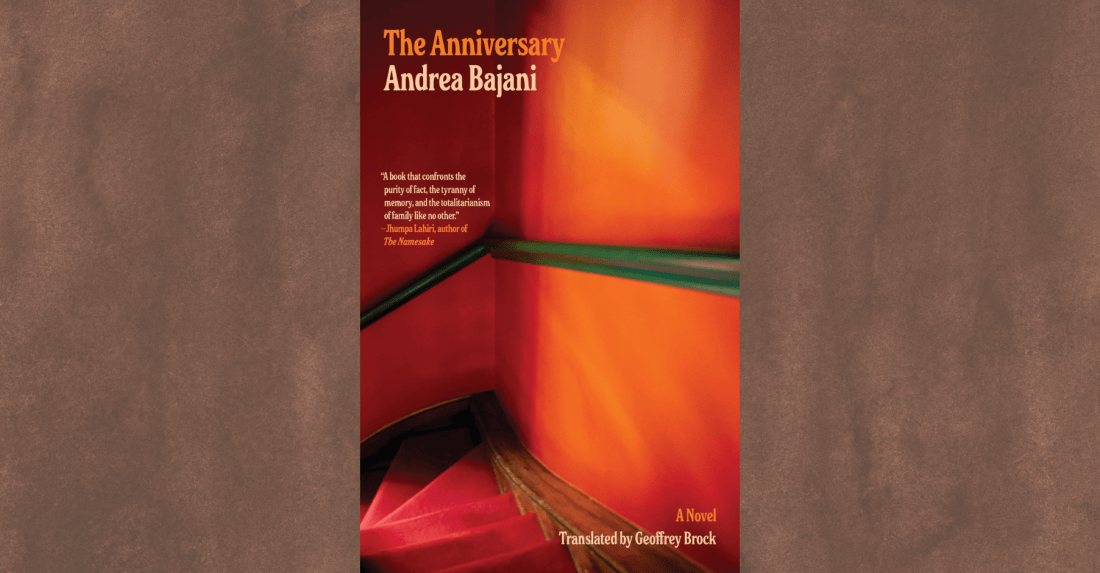
Andrea Bajani’s The Anniversary, recently translated into English by Geoffrey Brock after winning Italy’s coveted Premio Strega prize in 2025, is a novel that reads almost like a memoir. The Anniversary’s narrator is also positioned as the man penning the book, using its pages to retrace and untangle his history with his parents, with whom he cut off contact 10 years ago — the anniversary the title refers to.
The novel arrives at an interesting juncture in therapy culture, amid a rise in young adults deciding to go “no contact” with their parents and proliferating acknowledgment of trauma and its lasting impacts. The Anniversary’s narrator, who remains unnamed, experienced an inarguably traumatic childhood: His father was a violent, oppressive man who abused and controlled his mother, who the narrator views at times as both a victim and as an abettor.
Interestingly, though the father is the instigator within the household, it is the mother who is the novel’s starting point. The book opens with the last time the narrator sees his mother, standing alone at the threshold of their family apartment, watching as he descends the stairs. In that moment, his mother asks him, “‘Will you visit us again?’” Despite all that he has endured, he realizes that this question “was one I had never before asked myself, one that had never even occurred to me to consider.”
Therein lies the central question of this novel, a tension that seesaws throughout: one of agency, particularly as it relates to family. What obligations do we have to our family of origin? What, if anything, do we owe them? And even if we choose to separate ourselves from them, can we ever truly escape, or are we ultimately too psychologically embedded, such as that our family is ultimately our fate?
The narrator observes throughout the novel how his entire family is conscripted into roles that they do little to buck. His mother, much to his bafflement and oftentimes anger, acquiesces to the extreme limits the narrator’s father places upon her. While his father reigns so dominant that his hand seems to steer every decision for the household, his mother wilfully disappears to such an extent as to nearly erase her own agency (though the narrator wonders how much that, in turn, becomes itself an act of decision). His sister, both in the family life and in the novel, is largely absent.
The narrator also realizes his own participation in the system. Writing about an incident in his childhood when the neighbors called the police reporting a domestic dispute, he recalls entering his house to see “the wound” on his mother’s head, the “blood in her hair,” and “the ceiling light shattered on the floor.” Yet, he starts the chapter: “It’s still not clear to me whether my father actually hit my mother.”
Even as an adult, it is clear the narrator still struggles to make sense of what he has been through. The narrative reads elliptically, circling the subject matter, approaching it from one angle and then another without gaining clarity or traction. Rather than dwelling in a scene and recreating its full details, the narrator instead will often retreat back to his adult self, slipping into a therapized analysis, clearly well-honed from his years of sessions. Not much ever really fully and satisfyingly reaches definitive conclusions. The questions remain ongoing, the sorting forever unfinished.
This, though, is akin to the work of therapy. In doing the work, you start to pull at threads in an attempt to remember, reinterpret, and thus reclaim what has happened to you. The process is rarely linear, and it’s entirely reliant on recountings. Often, the most painful bits require repeated revisitings before things become clear. And even then, the answers you turn up may not be so simple.
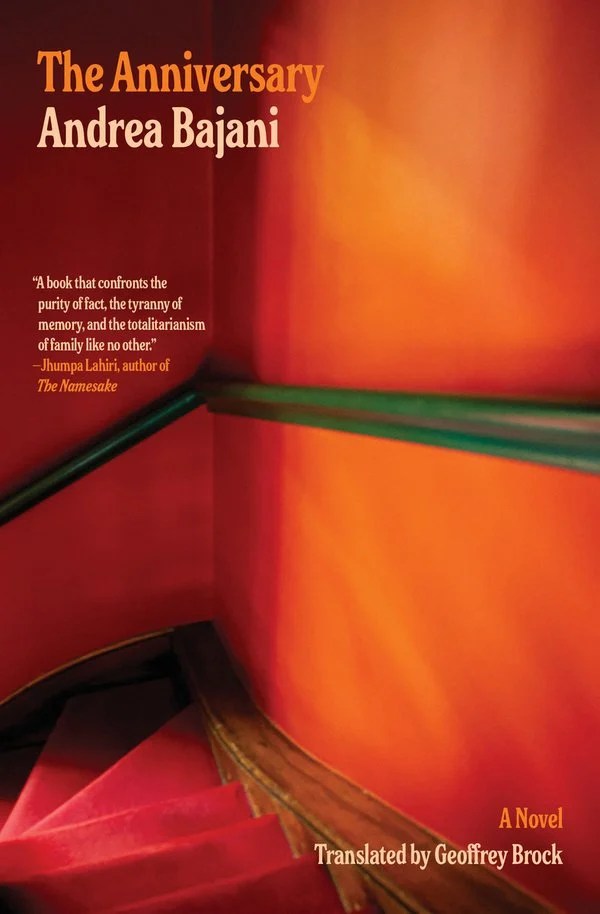
FICTION
The Anniversary
By Andrea Bajani; Translated by Geoffrey Brock
Other Press
Published August 25, 2026


